
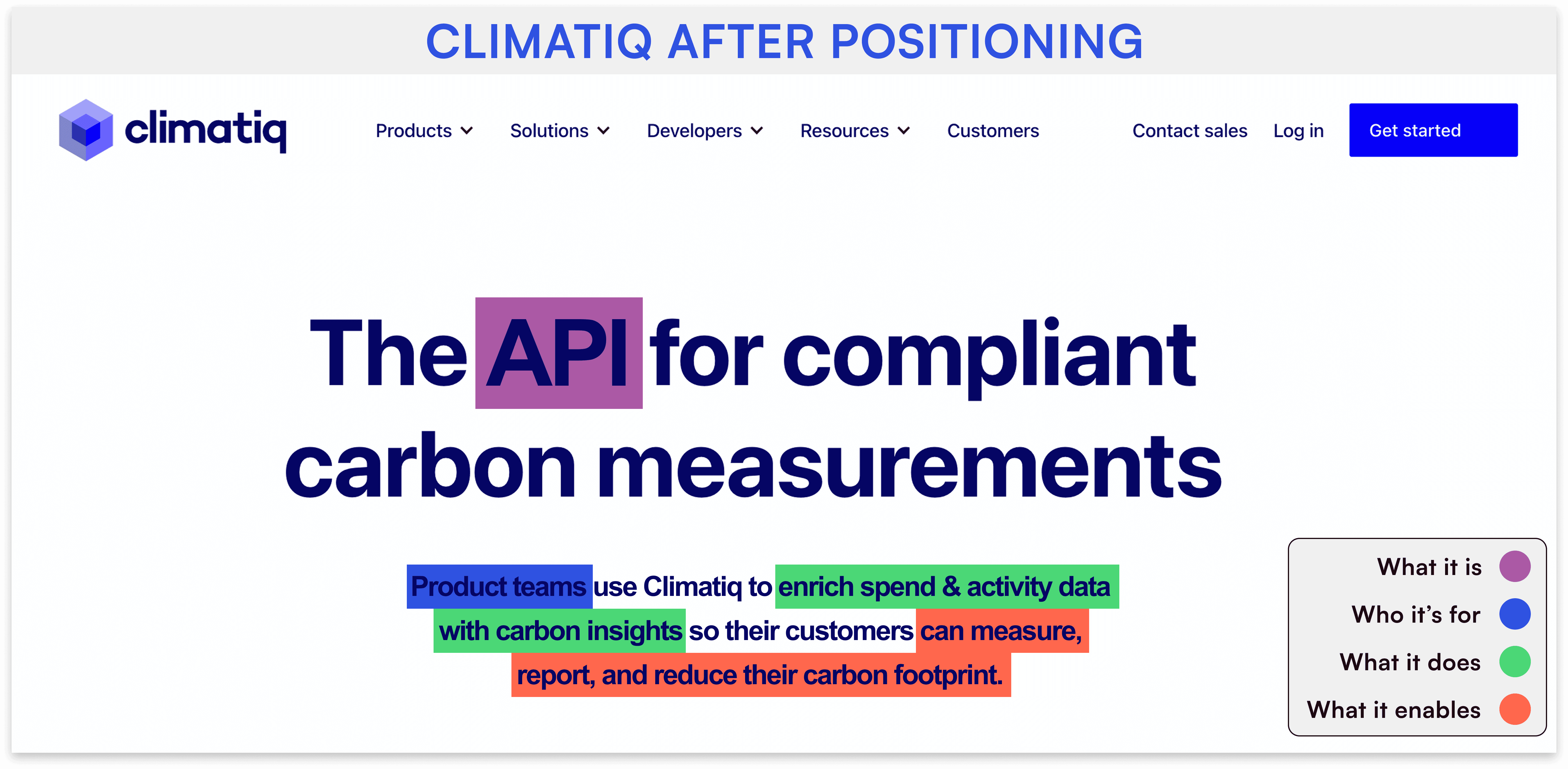
Climatiq is a carbon calculation API. ERP and SCM platforms use their API to turn activity and spend data into carbon insights, so their customers can automate emissions measurement, reporting and reduction.
Powerful Tech, Puzzled Prospects
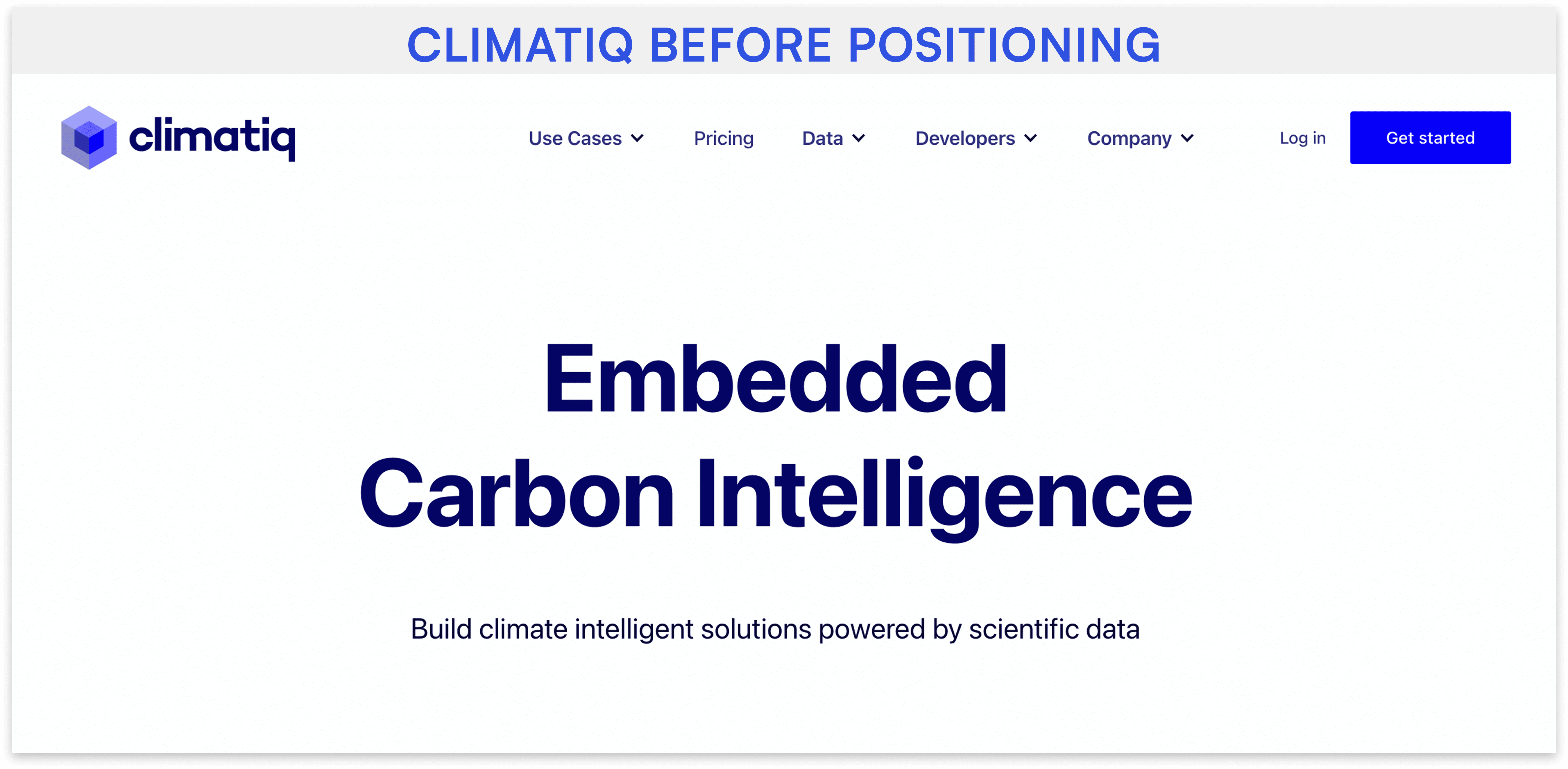
Climatiq’s challenge was that their carbon calculation API, while powerful, was too complex for customers to understand and buy. Visitors to the website often left unsure whether Climatiq was a data provider, a full calculation engine, or a standalone platform.
Sales conversations drifted into technical debates instead of focusing on what prospects could build with automated, real-time emissions data. This slowed the sales cycle and led to confusion, with some prospects even thinking Climatiq offered a frontend carbon calculator interface rather than an API.
Finding the Best-Fit Customer
Climatiq’s existing customers were diverse: supply chain management platforms, ESG software providers, large enterprises building internal systems, and platforms like Salesforce, who integrated Climatiq’s data into their own offerings.
The breadth of customers posed a problem: while the flexibility of Climatiq's API meant that they could all use it, this same flexibility made it difficult to consistently communicate Climatiq's value. To fix this, we identified one best-fit segment to focus on first, with plans to expand later.
The clearest opportunity was in ERP and supply chain management (SCM) platforms. Manufacturers everywhere are facing growing pressure to measure and reduce their greenhouse gas (GHG) emissions — over 90% of which occur within their supply chains. ERP & SCM platforms are being asked to by their customers for help tracking their emissions.
ERP and SCM platforms, however, lack reliable and up-to-date data, struggle to map emission sources accurately, and face uncertainty around calculation methods and changing regulations. Climatiq could solve all three.
Focusing on platforms also made commercial sense. A single integration could enable emissions tracking for thousands of manufacturers, multiplying Climatiq’s reach through a B2B2B model and aligning perfectly with their volume-based pricing strategy.
Product Packaging for an API-First Business
Climatiq initially offered its solution as a single integration, but this created pricing challenges. Each customer used different API features — some essential, others unused — which made pricing inconsistent and difficult to standardise.
Climatiq’s best-fit customers — ERP and SCM platforms — fell into two core groups. The first wanted to use Climatiq’s verified emissions data to build their own calculations and insights, seeing this as a source of differentiation. The second preferred to focus on their core expertise rather than learning new industry-specific calculations.
To serve both, we created two distinct products:
DATA — a complete dataset for platforms that want to handle their own mapping and build their own CO₂e calculations.
CALCULATE — an end-to-end solution for platforms that want automated, accurate CO₂e calculations.
However, some prospects were still unsure what they could build with Climatiq. To clarify this, we defined two use cases that reflected their maturity journey:
Carbon Measurement — for customers who want to measure their footprint.
Carbon Action — for customers who have already measured and now want to reduce it.
To make these use cases tangible, we created dedicated web pages for both Carbon Measurement and Carbon Action. These pages show what platforms can build for their customers, starting with reports and dashboards with Carbon Measurement, then progressing to hotspot analysis, supplier evaluation, and more through Carbon Action.
Next, we linked each use case to a metric-driven customer story, tying the products and use cases directly to customer outcomes. This link between use cases and real-world results made it easier for prospects to see how Climatiq helps them.
Building the Narrative Around Carbon as the Third KPI
Finally, Climatiq needed to tie themselves into a larger conversation — one about where the market is heading. A story that highlights the opportunity for platforms that adapt, and the risk for those that don’t.
The shift underway: carbon is moving from a tick-box exercise in compliance and reporting to a measure of business performance.
For years, business performance was measured through profit and cost. Now, a third dimension is emerging. Three forces are driving it:
Regulations: Governments have set ambitious net-zero targets, but it falls on businesses to deliver.
Investors: 58% of Fortune 500 companies have committed to net-zero, and investors are rewarding companies that can back commitments with credible data.
Stakeholders: Customers and employees expect action. Gartner predicts that by 2026, 70% of technology leaders will have sustainability goals.
Together, these pressures are making emissions management as central to business performance as profit and cost. It’s not a question of if, but when.
Climatiq’s position is that carbon is the third KPI, and should be seen as a strategic asset, not a reporting burden. Managed well, it can attract talent, investment, and trust, while improving efficiency.
We built this view into all of Climatiq’s communications, from web and social content to thought leadership and sales materials, positioning the company at the centre of this shift. In July 2025, Climatiq raised their $12M Series A.