
Enode builds the digital infrastructure for a zero-carbon future. Energy businesses use Enode’s APIs to help their customers connect and optimize their own energy devices like EVs, home batteries, solar inverters, and HVACs.
Powerful Product, Puzzled Prospects
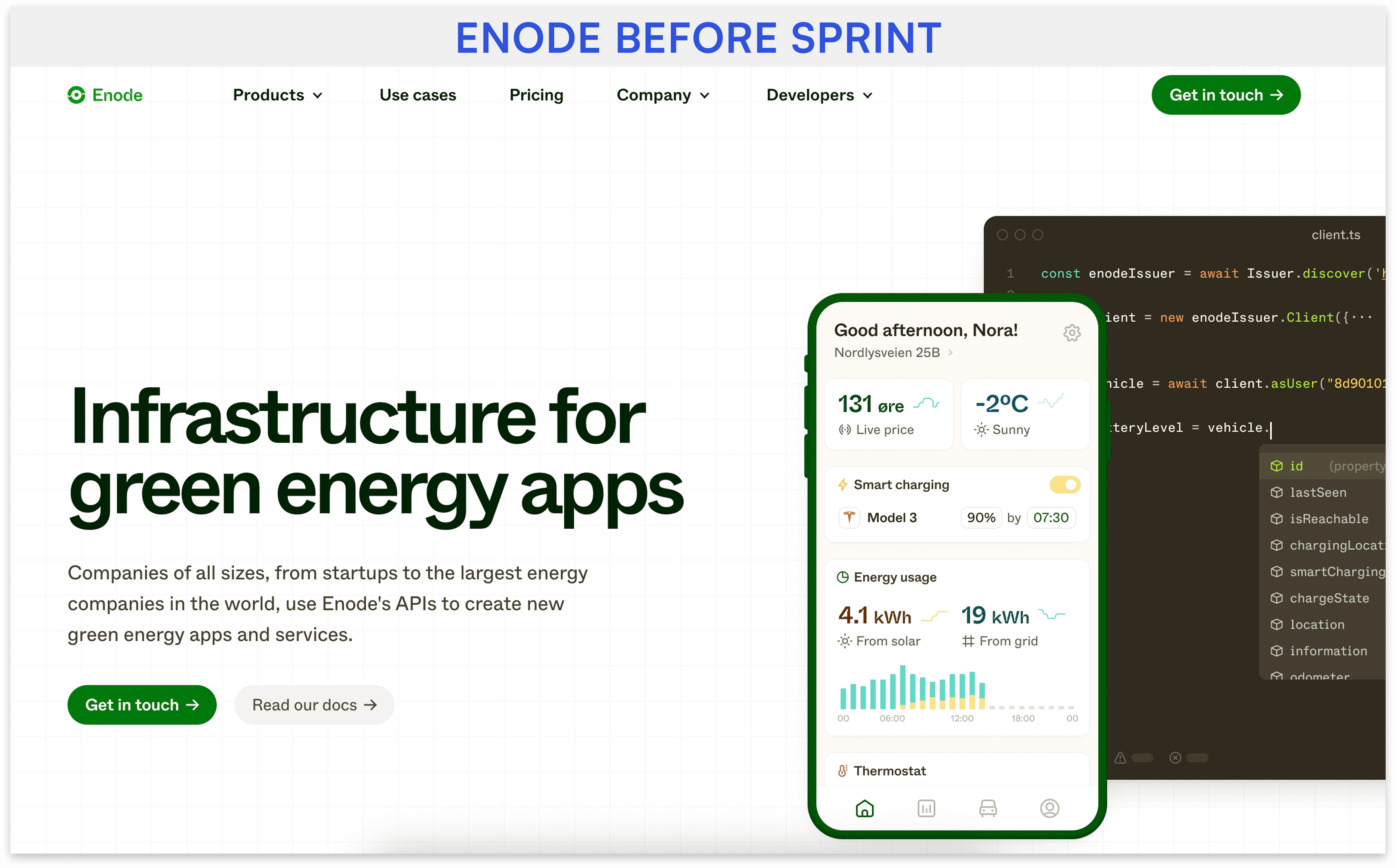
Enode’s challenge was that their product, while powerful, was too complex for customers to understand and buy. Visitors to the website often left unsure what Enode actually provided, asking questions like: “Do you build the front-end application?” or “What other components do I need?”
Sales conversations drifted into technical debates rather than focusing on what prospects could build by connecting multiple energy devices through a single API. This confusion, including the misconception that Enode built white-label front-end apps, slowed down the sales cycle.
Identifying Ideal Customers in an Emerging Category
In an emerging category, identifying true competitors is tough. There were players with overlapping offerings, but none doing exactly what Enode did. Most focused on connecting to just one type of energy device, like solar panels or EVs.
One major player offered something similar, an API for vehicle data, but their focus was on fleet management: tracking mileage, maintenance, and operations. Their value proposition stopped short of what Enode enabled, connecting not only to EVs but also to HVACs, home batteries, and solar panels.
As we dug deeper, it became clear that Enode’s biggest competitor wasn’t another company, it was inaction. The sheer number of device models and brands, plus the cost of integration and maintenance, made it feel like an endless project. Building and maintaining these integrations internally would take a dedicated team several years to complete.
This realisation shifted the strategy. Instead of competing against other players, Enode needed to compete against inaction. The opportunity lay with large energy providers that already had consumer-facing apps, like Total Energies. Providers with a large existing customer base but lacking the engineering resources to connect devices at scale.
By taking care of the integration heavy lifting, Enode freed energy providers to build customer-facing features that help households to optimise their energy use and cut costs.
That insight also refined our target personas. While API companies typically focus on Developers and Product Managers, this emerging category meant we needed to target more senior decision-makers.
CTOs and CPOs were key to building momentum. While Developers and Product Managers plan up to a year ahead, these leaders think two to five. Much of what Enode enables was seen as years away, but by showing that this future was already possible, we gave them a reason to act now.
Showing Enode’s Value Through Use Cases
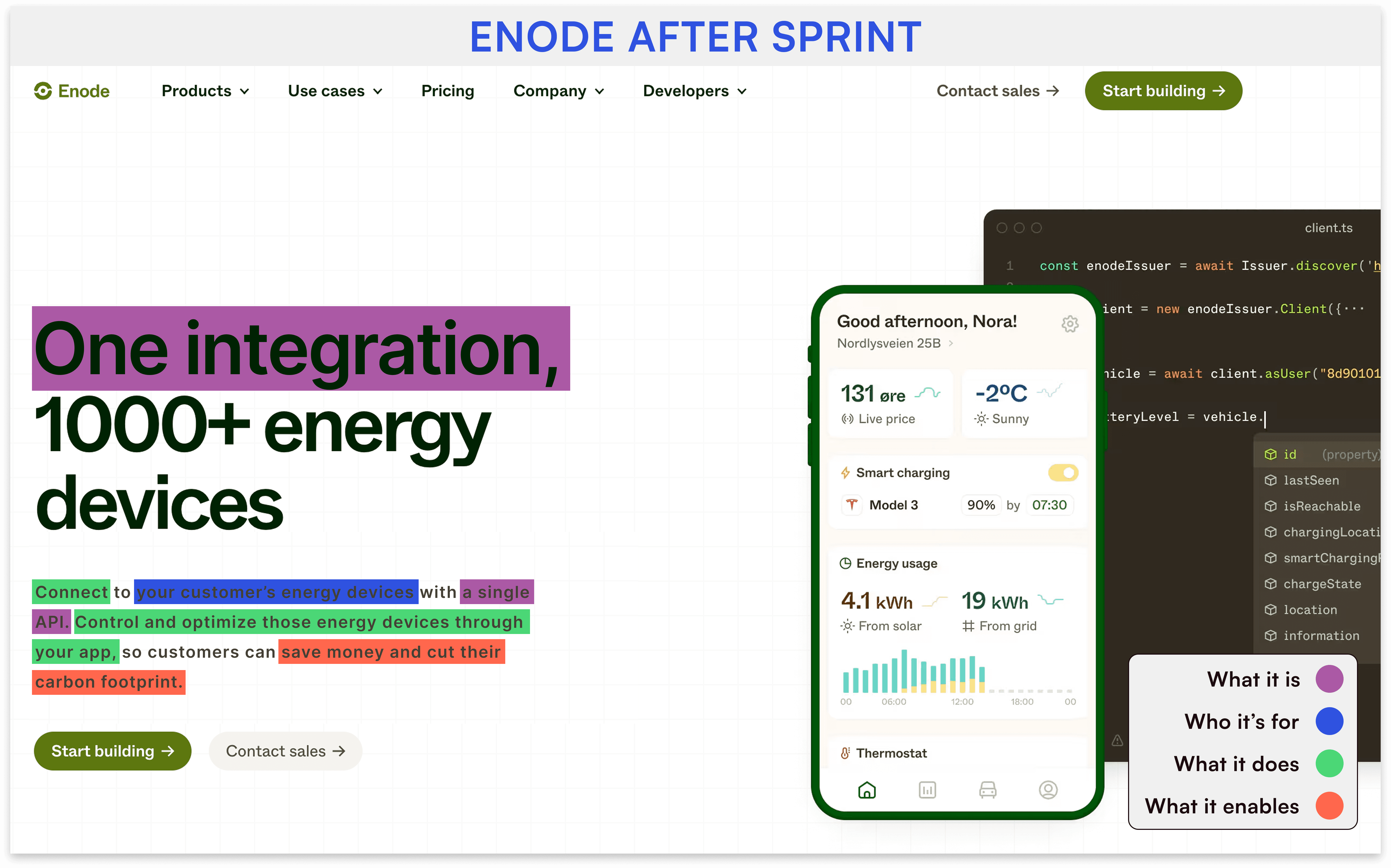
While Enode’s products, Connect, Optimise, and Aggregate, were well-defined, it wasn’t clear what prospects could actually build with them.
To bridge this gap, we mapped out concrete use cases for each product. Some examples include:
Home Energy Management – Users connect their energy devices to work together automatically, lowering energy bills.
Demand Response – Automatically adjusts a user’s connected energy devices during peak times to balance the grid by reducing or shifting electricity use.
Smart Charging – Automatically starts and stops EV charging during off-peak hours to save costs and reduce grid strain.
We then created dedicated landing pages for each use case, clearly outlining which components were required and Enode’s specific role within the solution. We also simplified the language, replacing technical terms like "DER" (Distributed Energy Resources) with more accessible ones such as "Energy Device", a term we coined to describe any device that produces or consumes energy.
Each webpage also featured customer success stories with measurable results — such as a 29% reduction in household energy bills and 20% lower home EV charging costs — making Enode’s value tangible and easy for prospects to understand.
Defining the Narrative for the Open Energy Era
Beyond positioning, we needed to connect Enode it to a bigger narrative, one about where the energy industry is heading. A story that highlights the opportunity for companies that adapt, and the risk for those that don’t.
Today’s energy system is centralised, built around large power plants and ageing infrastructure that struggle to meet the demands of electrification and renewable energy. The future will look very different. At Enode, we believe energy will be decentralised — powered by millions of distributed energy devices like solar panels, EVs, and home batteries. These devices will be connected through software, automatically responding to grid signals and working together to balance supply and demand.
We call this future Open Energy.
Just as Open Banking transformed finance, Open Energy will transform energy. Before Open Banking, customers had little visibility or control over their financial data. Interoperability changed that. It enabled transparency, innovation, and choice.
Open Energy will do the same for energy. It will give consumers visibility and control through connected devices, helping them lower energy bills or even earn money by selling power back to the grid. It represents a shift from closed, siloed infrastructure to an open, intelligent, and more sustainable system.
We built this narrative into every part of Enode’s story — from investor decks, which the team used to raise their $15M Series A, to website copy, thought leadership, PR, & sales materials.