
ESG Book is a sustainability risk and compliance platform. Financial institutions use ESG Book to access validated public & private sustainability data mapped to frameworks for sustainability reporting, financing & supply chain decarbonisation
Powerful Platform, Unclear Position
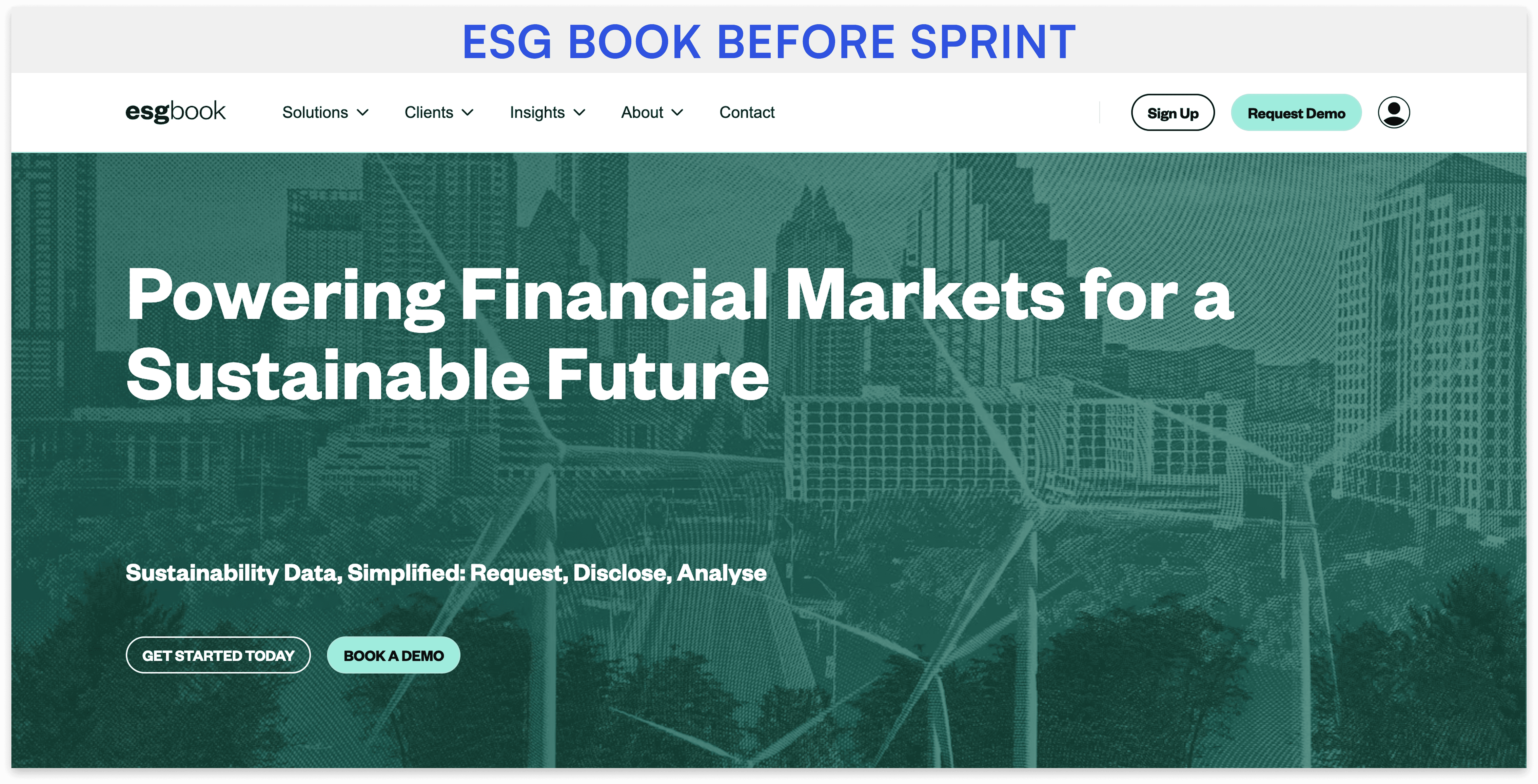
ESG Book had built one of the most comprehensive sustainability data platforms in the market, combining public company disclosures with private data collection, validation, and analytics. Yet despite the product’s depth, the positioning didn’t clearly communicate what ESG Book was or who it was for.
Some prospects saw it as a data vendor. Others assumed it was a carbon accounting tool or a corporate disclosure platform. Sales conversations often became overly technical, centering on data methodologies or modelling approaches instead of the outcomes customers could achieve.
Even internally, teams found it difficult to draw a clean line between features and value. Was ESG Book an analytics product, a reporting platform, or a workflow tool? The answer often depended on who you asked.
The result was a business spread across multiple audiences with very different needs — individual investors, private companies, and financial institutions. Without a clear category or unified message, ESG Book risked being seen as a collection of strong capabilities rather than the platform that enables sustainability risk and compliance at scale.
Finding the Right Customers in a Maturing Market
The sustainability data market had grown crowded and noisy. Dozens of providers were competing across carbon accounting, ESG scores, and impact analytics, often selling overlapping data in different formats. But few were solving a real operational pain: sourcing private company data without overburdening customers, standardising and validating it, and then mapping it to the right regulatory reporting frameworks.
As we looked closer, the opportunity became clear. The customers feeling the most pressure were financial institutions trying to comply with regulations like EBA PIII, CSRD, SFDR, and EU Taxonomy while building internal systems for transition finance.
These organisations lacked a reliable way to connect sustainability data to risk and regulatory workflows. They didn’t need another ESG dataset. They needed infrastructure — a system of record that could unify, standardise, and distribute sustainability data across functions.
This insight shifted ESG Book’s focus from being one of many ESG data providers to becoming the platform that powers how financial institutions collect and manage sustainability across their organisations.
Simplifying Products, Packaging and Use Cases
To make the platform easier to understand, sell, and price, we organised it into two clear products that align with how banks and financial institutions actually operate.
Access gives institutions structured, standardised, and auditable public sustainability data through APIs and data feeds. It serves teams building analytics, scoring models, and disclosure tools internally.
Engage includes Access, plus the ability to collect private sustainability data and map both validated private and public data to relevant reporting frameworks, automating regulatory reporting.
But the challenge remained: how could ESG Book show that sustainability data was valuable beyond regulatory reporting? We wanted to show it could support multiple use cases and be embedded across teams. We defined three key use cases to illustrate how financial institutions could build with ESG Book.
Sustainability Reporting: increase data coverage and completeness, build trust in your data, and reduce manual work for regulatory submissions.
Supply Chain Decarbonisation: replace spend-based estimates with real data, automate supplier emissions collection, and identify high-emitting suppliers.
Transition Finance: grow sustainability lending volumes with validated borrower emissions data, track progress, and flag missed targets.
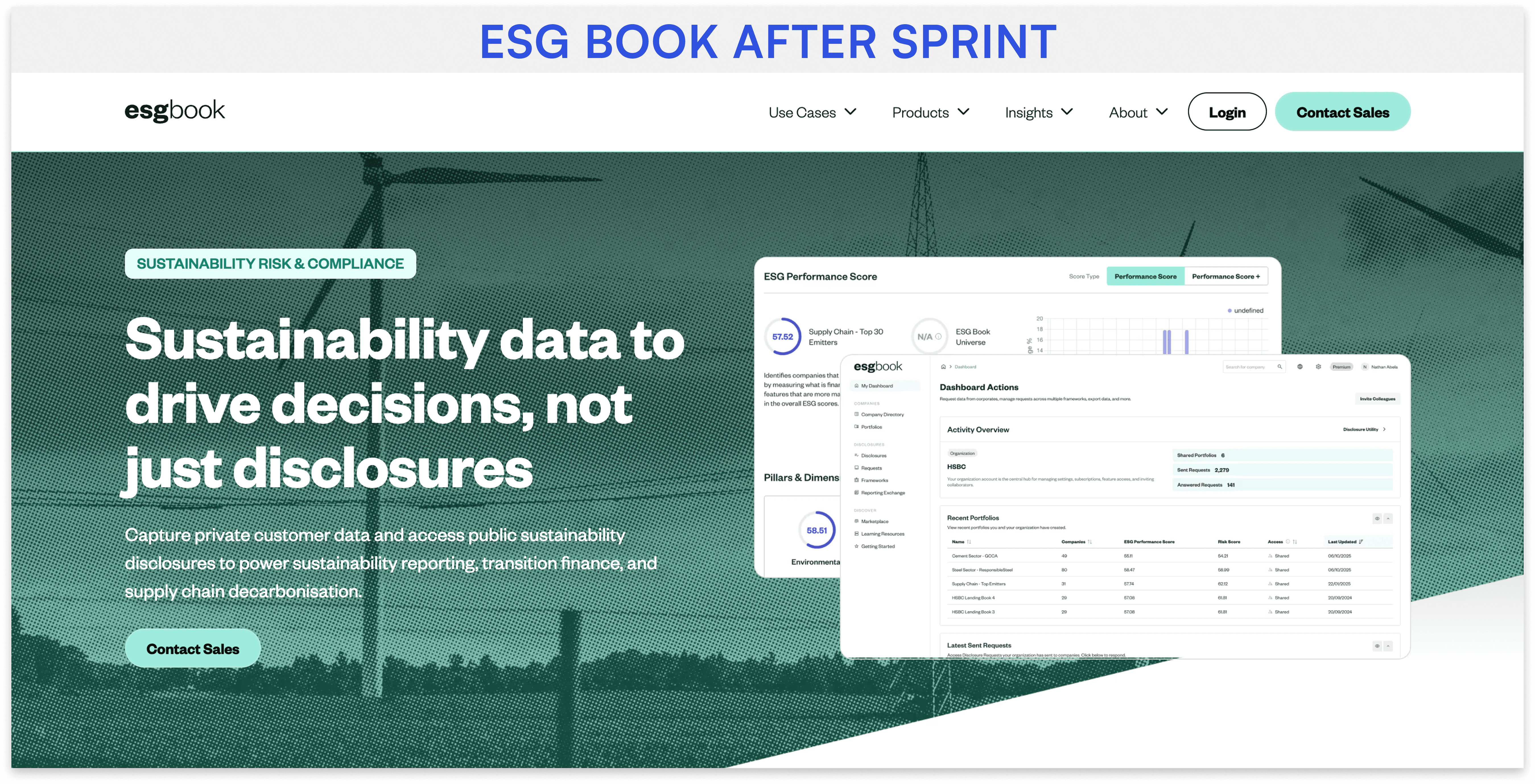
The result is a platform that reflects how customers actually experience value — two connected products and three use cases serving different parts of the same institution. Each product and use case addresses specific operational and strategic needs, from compliance to risk management to growth in sustainable finance.
This clarity shortened sales cycles, simplified positioning conversations, and made it immediately obvious where ESG Book fits in a bank or financial institution’s existing technology stack—whether for regulatory reporting, operational decision-making, or growth in sustainability-linked products.
Defining the Narrative: From ESG Data to Sustainability Infrastructure
Beyond product clarity, ESG Book needed a story that reflected the scale of change in sustainable finance.
For years, sustainability data was treated as an afterthought; a reporting requirement managed in spreadsheets and annual reports. While all other financial data has moved to real-time, sustainability data remains retrospective and updated only once a year.
Yet today, it underpins decisions on lending, risk, and growth. It is becoming core financial infrastructure. This shift became the foundation of ESG Book’s narrative: sustainability data will be real-time and embedded across every function.
Where others focus on scores, ratings, or one-off datasets, ESG Book positions itself around the systems that make sustainability data usable — real-time, standardised, and connected across functions. Its products go beyond helping customers comply with regulations; they help institutions build new products across transition finance, supply chain decarbonisation and more.
This story now runs through every part of ESG Book’s go-to-market — from investor materials and website copy to how sales teams frame value in client conversations. It positions ESG Book not as just another ESG data provider, but as the infrastructure layer helping the financial system shift toward sustainable growth.