onu.energy is an energy procurement platform. Procurement managers rely on onu.energy to turn price and demand volatility into an advantage with connected data, analytics, and trading tools across the entire energy procurement lifecycle.
Powerful Platform, Unclear Position
onu.energy had built a powerful product. The platform could do a lot — track consumption, analyse coverage, and execute trades — yet customers still struggled to understand why it mattered.
Sales conversations often stalled because the team couldn’t clearly link product capabilities to customer outcomes. There was uncertainty over what counted as a feature versus a product, or how to articulate value beyond a broad promise of “energy analytics.”
Existing users weren’t taking advantage of the full functionality either. The product offered depth — dozens of charts, dashboards, and data points — but lacked the clear guidance and recommendations that helped users act. There was almost too much information.
The result was a strong platform trapped behind a weak story — one that made it difficult for prospects to see onu.energy as a must-have, rather than just another analytics tool.
Finding the Right Customers in a Fragmented Market
Energy procurement is a fragmented and manual process. The way businesses plan and buy their energy varies widely. Most rely on Excel spreadsheets, others work with consultants, deal directly with their suppliers, or use energy management solutions. But none of these alternatives show the full picture.
What’s missing is a single system that brings everything together. A system that connects market prices and consumption data, provides insights and strategy recommendations, supports reporting and trade execution, and helps manage energy procurement from start to finish.
The companies that felt this gap most acutely were energy-intensive industries managing procurement in-house but struggling to do so efficiently. These teams typically had a Procurement Manager responsible for building an energy strategy, forecasting demand, purchasing, and reporting across multiple sites.
Energy strategy and trading wasn’t their core competency. Most Procurement Managers were doing the best they could with manual processes and spreadsheets, managing energy planning and strategy alongside a dozen other procurement priorities. They weren’t trying to outsmart the market or become traders. They simply wanted to avoid mistakes, reduce manual work, and prove to leadership that energy costs were under control.
There were three industries that stood out: Food & Beverage, Manufacturing, and Logistics.
In Food & Beverage, energy demand is constant because of refrigeration, cooling, and heating, which leaves little flexibility to shift usage.
In Manufacturing, processes like forging, casting, and heat treatment are moving from fossil fuels to electric, creating larger load profiles and sharper demand spikes.
In Logistics, fleet electrification is increasing energy consumption across depots, client sites, and petrol stations, adding new layers of operational complexity.
Across all three, the pattern was unmistakable. Each shared the same structural challenges: round-the-clock operations, distributed sites that made planning and reporting complex, and rising demand from heat & fleet electrification. These became onu.energy’s core customers — companies for whom volatility was a daily operational reality.
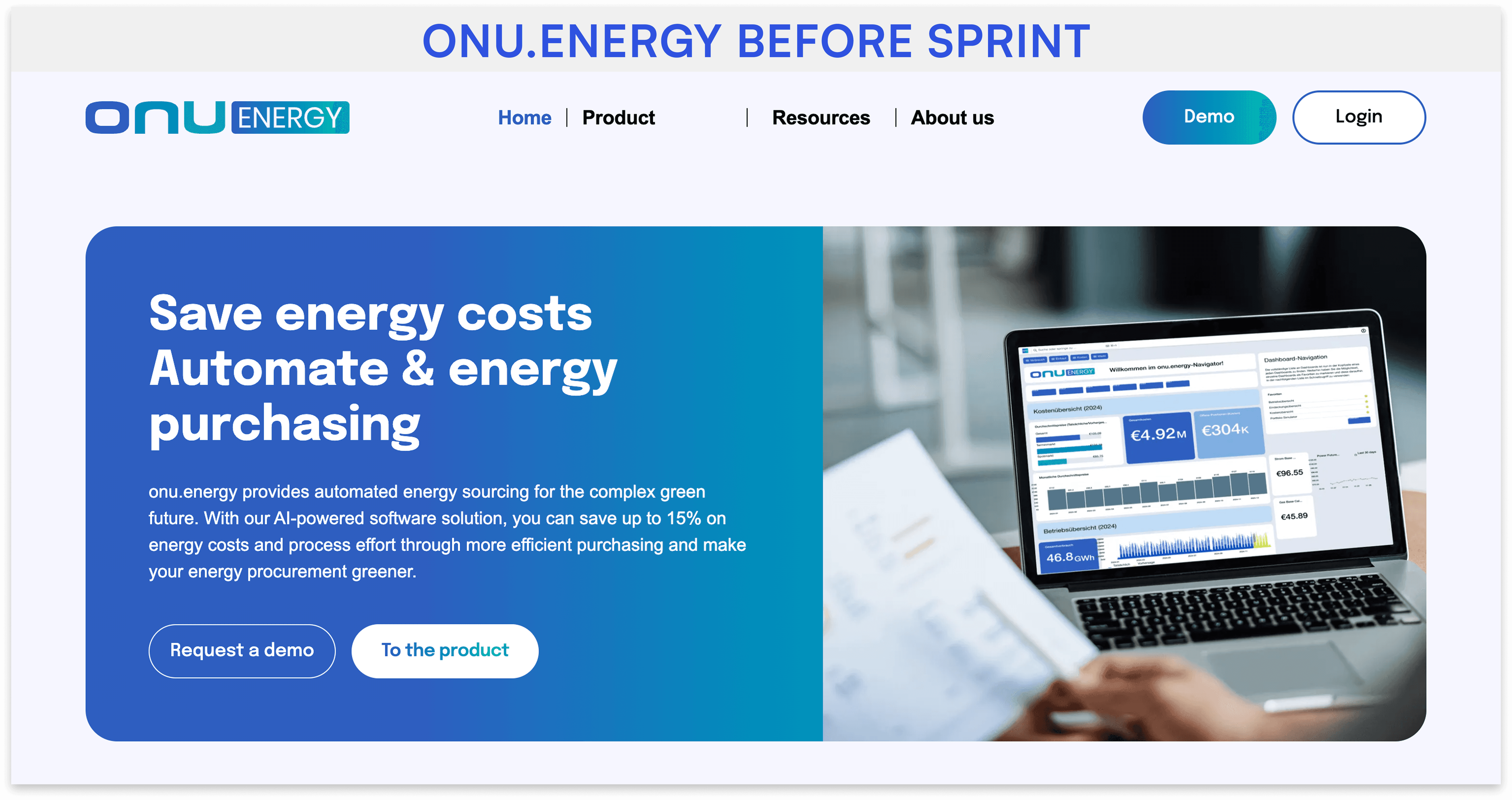
Simplifying Products and Packaging
To make the platform easier to understand, sell, and price, we reorganised it into two clear products that mirror how Procurement Managers actually work.
Analytics helps teams see, plan, and report on energy data. It brings together everything they need to monitor consumption across sites, track coverage positions, and forecast costs and risks. Before, this information lived in separate spreadsheets and dashboards. Now it’s connected in one place, updated automatically, and ready to share with finance and leadership.
Trading helps teams simulate, recommend, and execute energy purchases. It turns analysis into action by combining live market data with the company’s own coverage strategy. Procurement Managers can test different buying scenarios, run “what if” simulations, and receive trade recommendations based on price movements and risk tolerance.
Each product was tied to concrete outcomes under three company level value pillars that every Procurement Manager cares about:
Cost Reduction – Lowering the average purchase price through simulations, trade recommendations, and optional AI-driven trading.
Risk Management – Improving forecast accuracy and coverage tracking with live market and consumption data in one system.
Operational Efficiency – Eliminating manual spreadsheets with integrated analytics, automated data updates, and easy reporting.
We also simplified pricing by adopting a clear structure: a flat monthly platform fee plus a performance-based success fee tied to actual savings. This made the value transparent and aligned incentives between onu.energy and its customers.
The shift reframed onu.energy from a collection of features into a complete system for energy procurement — one that helps teams turn volatility into an advantage instead of a threat.
Finally, these insights fed directly into the product roadmap. We prioritised what mattered most to Procurement Managers: better reporting, actionable recommendations, and integrations with suppliers and internal systems.
Redefining the Narrative: From Fixed to Flexible
Beyond repositioning, onu.energy needed a story — one that connected its mission to the broader transformation happening in the energy market.
For decades, energy procurement has been built around stability. Long-term contracts, rigid budgets, and predictable prices made procurement a once-a-year process rather than a continuous decision. Companies could set a strategy, lock in prices, and move on.
That world no longer exists. Volatility driven by geopolitics, electrification, and the rapid growth of renewables has made energy markets more dynamic than ever. Prices change by the minute. Demand is harder to forecast. Renewable generation fluctuates with the weather. The assumptions that once made fixed contracts safe now make them limiting.
The future will be flexible.
And flexibility doesn’t begin with batteries or demand response technology. It begins much earlier…with procurement. This became the foundation of onu.energy’s new narrative: From Fixed to Flexible.
Where most of the market sees volatility as a threat, onu.energy frames it as an opportunity — an opportunity for companies to regain control, act faster, and make smarter purchasing decisions. By using data, analytics, and automation, procurement teams can adapt in real time, optimise their coverage, and turn uncertainty into an advantage.
The narrative positions onu.energy as an enabler of the new energy era — one defined by adaptability, intelligence, and confidence in the face of constant change.